
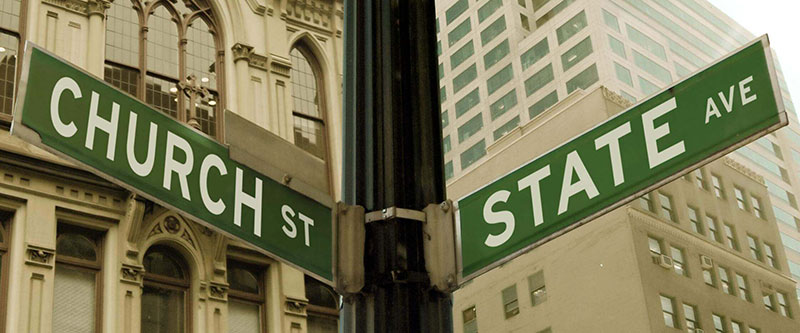
The previous installment dealt with the specific controversial practical applications included in Christian Nationalism. It continued to follow the basic illustration of how to interact with this political theory. Some of what it asserts is like balls that land squarely in the fairway. There is much to be learned and agreed on in what it says, mostly summarized by a robust understanding of the civil use of the moral law. But when it comes to working out those generally good ideas, the ball rolls into the rough. Blood pressure is up, swings are taken, and there may even be a club that is thrown from time to time. Never is that more obvious than when the question of a national church is raised.
Should there be a state, or established church or not? Can the civil magistrate call synods or not? Again, Presbycast had a lively and lengthy discussion on this point in their debate on Christian Nationalism.[1] This may be the thorniest of them all because it involves arguments about the original text of the Confession of 1647 compared to the American revisions adopted in 1788. Personally, I am uncomfortable with a civil magistrate who has any kind of power or jurisdiction over the Church. It comes from my presbyterian convictions that the church should be governed by a plurality of elders, not civil servants, elected or otherwise. The same principle is applied in the other direction. I would love to have a government that asks the Church for advice on its legislative plans, but I would not want the church to make policy decisions. Likewise, I am profoundly uncomfortable with a magistrate who can direct any part of the theology, ministry and government of Christ’s Church.
These five points above do not have universal agreement by any stretch of the imagination. In my own views, I am sympathetic to the Christian Nationalist call to exercise the civil use of the law in the first, third, fourth, and seventh commandments, and I am opposed to a state or national church. People may think I am “in the rough,” but I doubt there will be accusations of sin against me. They might say I lack wisdom, but there is a recognition that working out the details of a “good society” is complicated and discussion and debate must be had. When the ideal of the civil use of the moral law bumps up against the reality of fallen and sinful society, the ways to apply this use may cause head scratching and disagreement. And because there is significant disagreement on this matter in the relatively small group of Reformed Christianity, making any kind of dent in society requires even more delicacy and careful statesmanship. The United States in the 21st century is thousands of moral miles away from Calvin’s Geneva or some other utopia from the past, and it makes a quick return to the civil use of God’s law humanly speaking highly unlikely in the short term.
At this point, the question will be more about how to get the magistrate to acknowledge God’s law at all rather than enact specific legislation. One of the things that struck so many Christians in the aftermath of Charlie Kirk’s assassination, was that at his memorial service, many magistrates from President Trump’s cabinet made explicit reference to the gospel and mentioned sin, forgiveness in Jesus, and other such Christian ideals in their addresses. And as grateful as Christians should be when their leaders openly acknowledge the message of the gospel, there has not been a swell of legislation that returns the United States to a civil use of the moral law as far as I can tell. That leaves Christians to consider the question of Christian Nationalism more as theory. It can be helpful. The civil use of the moral law is what should be the target as far as I’m concerned. And yet it the application is not so simple.
Do Christians hope that all people would worship the one True God? I should hope so. Otherwise, what are we doing when it comes to the Great Commission. And what would happen if God would bless the evangelistic efforts of the Church? Societies would become Christian. For myself, if I would like my country to be a little Christian, so why would I not want it to be a lot Christian? But since the applications represent the rough rather than the fairway, it is not surprising when there is some disagreement about the magistrate’s role in getting there. Christians should be able to have strong biblical convictions here, while at the same time not demonizing brothers whose views differ from their own. And yet there is also a proper place for warning, where proponents of Christian Nationalism loose the plot. Several instances will be highlighted and examined in the next few articles.
Pastor Geoff Gleason
Cliffwood Presbyterian Church

—————
[1] Presbycast, “Continuing the Debate: Church & State,” YouTube video, accessed December 8, 2025, https://www.youtube.com/watch?v=hnOV-QdRoCM, starting at 13:00.